Let's Talk with Terry Ambrose
October 15, 2026
The Tehachapi Loop—a 150-year-old Engineering Marvel
Are You a Railroad Nut? I never thought of myself as one. But years ago, we visited a model train exhibition in San Diego, and I discovered something I hadn’t expected: I was fascinated by railroads—and especially by the railroads of days gone by.
Then came our own model train, The Christmas Express, which we enthusiastically set up and run during the holidays. Somewhere along the way, we found ourselves seeking out railroad history when we travel. Railroad museum? Awesome. Engineering marvel from the 19th Century? Count. Me. In.
The Loop
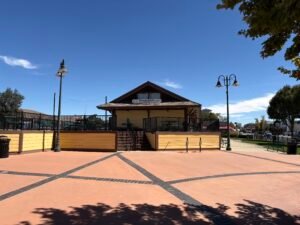
The Tehachapi Depot Railroad Museum is housed in a beautifully restored 1904 Southern Pacific depot. Inside, you can learn about the engineers, workers, and locomotives that tackled the formidable challenge of getting trains over Tehachapi Pass. The result is one of the coolest pieces of engineering I’ve ever seen—The Tehachapi Loop.
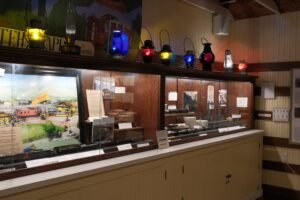
The museum’s exhibits include a relief model of the Loop. Our docent—a wonderfully enthusiastic senior who clearly loved railroads—explained how it came to be. Built between 1874 and 1876, the Tehachapi Loop was Southern Pacific’s ingenious solution to a very simple problem: How do you get a very long, very heavy train up a very steep mountain without making the grade too steep?
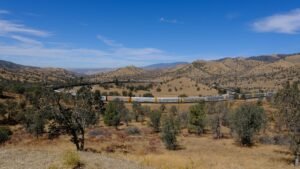
The answer was to make the railroad go around in circles.
Engineer William Hood designed a track that spirals around a hill and crosses over itself. The resulting loop allows a train to gain about 77 feet in elevation without exceeding a 2.2 percent grade.
Of course, designing it was one thing. Building it was another.
About 3,000 Chinese laborers carved the railroad through the rugged terrain using picks, shovels, and blasting powder. What they created more than 150 years ago is still in use today, carrying freight trains over Tehachapi Pass.
The Tehachapi Loop has since been designated a National Historic Civil Engineering Landmark.
Not bad for a railroad that was built with little more than muscle, determination, and some very creative engineering.
Built to Last vs. Built to Demolish
The Loop got me thinking about something entirely different.
In my upcoming Seaside Cove Bed & Breakfast Mystery, the town is facing a very different problem. A new engineering assessment has declared the town’s historic lighthouse unsafe. According to the report, the lighthouse is in danger of collapsing into the sea and must be demolished.
And because the lighthouse sits on his property, B&B owner Rick Atwood is the one who gets stuck with the bill.
There’s just one problem. Rick can’t afford to demolish a lighthouse.
But Rick is a former investigative reporter, and he knows better than most that timing can be everything. The sudden appearance of this engineering report strikes him as suspicious. Could there be something wrong with the report?
And if the lighthouse really is hiding something, what exactly is someone so desperate to erase?
Some engineering marvels are built to last. And some things are demolished because someone wants to make sure they don’t.
So, back to the question—are you a railroad nut? I’d love to hear your thoughts in the comments below!
Want to know more about our author Terry Ambrose? Visit his WEBSITE.
Don’t forget to enter our Booklover’s Bench contest. We’re collecting entries for TWO free books for one lucky winner. It runs from October 1-22. Here’s the link: https://bookloversbench.com/contests/
Posted in Let's Talk, with Terry Ambrose • Tags: BLB Discussion, museums, railroad, Terry Ambrose | 2 Comments







When we lived outside of Philadelphia, we weren’t far from Amish country, which included Strasburg, PA, home of the Railroad Museum of Pennsylvania, the Strasburg Railroad (with its excursion to Paradise, the railroad car from Hello, Dolly! and several Thomas the Tank engines,) the National Toy Train Museum, and the Choo Choo Barn. We made many day and overnight trips out to Strasburg for years with first our two sons, then with our grandchildren, even staying once in the Red Caboose Motel.
While I don’t consider myself a railroad nut, I have fond summer memories of traveling by train to visit a favorite aunt who lived a small town in Texas. And, as a student in France, of learning how to rapidly debark with luggage from a train in Europe that only stopped for 30 seconds at each station.